In short: what to choose
| Where it is installed | Best option |
|---|---|
| Private house with a boiler | Steel panel or aluminium |
| Apartment with central heating | Bimetallic |
| Large windows, panoramic glazing | Trench convector or low panel radiator |
| Designer interior | Vertical or designer radiator |
Below is why.
Aluminium radiators
They give off heat well, heat up quickly and are light. Sections can be added and removed.
The downside is that aluminium is sensitive to water quality. With acidic or overly alkaline heating water, corrosion begins. In a private house with a closed system and normal water this is not a problem. Examples are the GLOBAL Iseo and Vox series. In central heating the risk is higher.
Bimetallic radiators
Inside is a steel or copper core, outside is an aluminium body. Water is only in contact with steel, so the radiator withstands high pressure and water hammer.
This is the choice for apartment blocks with central heating. An example is the GLOBAL Style series. For a private house the extra cost is usually unnecessary: the pressure there rarely exceeds 2-3 bar.
Steel panel radiators
These are steel panels with convector fins between them. They hold little water, so the radiator responds quickly to the thermostat. They work well at low flow temperatures, paired with a condensing boiler.
Types by number of panels and convectors:
| Type | Design | When to choose |
|---|---|---|
| 11 | 1 panel, 1 convector | Small rooms, little space |
| 21 | 2 panels, 1 convector | Medium output with a small depth |
| 22 | 2 panels, 2 convectors | The most popular option for living rooms |
| 33 | 3 panels, 3 convectors | High output with a short radiator |
Dimensions. Height is usually 300, 400, 500, 600 or 900 mm, length from 400 to 3000 mm. The height is chosen according to the windowsill: 8-12 cm from the floor to the radiator, and at least 8-10 cm from the radiator to the windowsill.
Side or bottom connection
Side connection is the classic option, with pipes coming in from the side. It suits replacing old radiators in the same places.
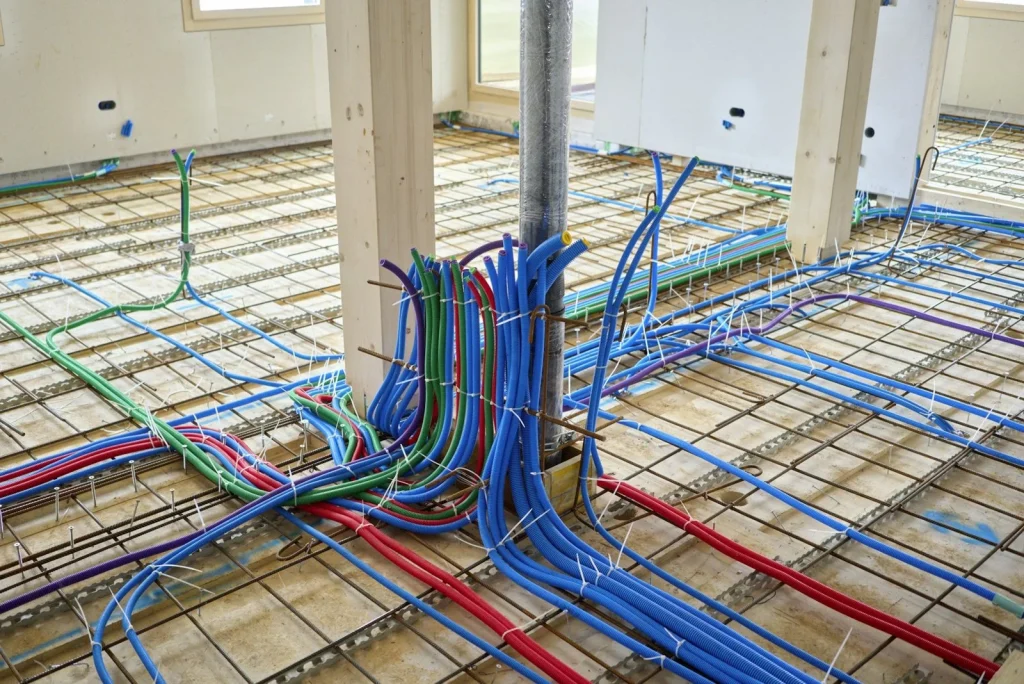
Bottom connection (VK models) — the pipes come out of the floor and look neat. A thermostatic valve is already built into the radiator: you only need to fit a thermostatic head. A good choice for a new house where the pipes run in the screed.
Vertical radiators with bottom connection are installed where there is no room for width: in a hallway, on a narrow wall section or in a bathroom.
How to read the specifications
- Power is stated for a specific operating mode, most often 75/65/20 °C. With a 55 °C flow, the same radiator gives off roughly half as much heat.
- Working pressure — usually up to 8-10 bar for panel radiators, higher for bimetallic ones.
- Volume of water — the smaller it is, the faster the radiator responds to the thermostat.
Important: choose a radiator for the temperature your system will actually run at, not by the maximum output in the catalogue.
Send ThermoHouse your room plan and the type of your system. We will select KERMI steel panel radiators or GLOBAL aluminium or bimetallic radiators to match the output and connection type. Contact us →